The Real Cost of Diagnostic Inefficiency
By Anthony Calhoun - 25-Year ASE Master Technician, Former Dealership Service Manager, Author of “Why Technicians Are Leaving and How to Keep Them”
Most service managers can tell you their door rate, their effective labor rate, and their hours-per-RO. Very few can tell you how much time their diagnostic techs spend on unpaid research every day. That blind spot is costing more than you think.
The Hidden Time Sink
Here is how a typical diagnostic job flows: the tech pulls codes, reads freeze frame data, checks for TSBs, researches pattern failures, reads forum threads, looks up wiring diagrams, and then builds a test plan. Only after all that research do they actually start testing.
That research phase takes 15 to 30 minutes per diagnostic job. On flat rate, it is completely unpaid. On hourly, it is time your tech is not turning wrenches. Either way, it drags down your shop’s productivity numbers.
If your diag tech handles 5 jobs per day and averages 20 minutes of research per job, that is 100 minutes daily. Over a month, that is 36+ hours of non-productive time from a single technician.
What That Costs in Real Dollars
At a $175 door rate, 36 lost hours per month represents $6,300 in potential revenue that your shop never captures. Per tech. Per month. If you have two diagnostic techs, you are looking at over $150,000 per year in unrealized revenue from research time alone.
And that number does not include the downstream costs: the jobs that got bumped because diag took too long, the customers who left because their car sat for an extra day, or the comebacks from rushed diagnostics when the tech tried to skip research to save time.
The Comeback Multiplier
When techs feel time pressure on diagnostics, they cut corners. Not because they are lazy - because they are trying to make a living on flat rate and cannot afford to spend 30 minutes researching every code. So they go with their gut instead of verifying. Sometimes they are right. Sometimes they replace a catalytic converter when the real problem was an oxygen sensor heater circuit.
Every comeback costs you a bay for the day, the tech’s time on warranty/goodwill, parts restocking or write-off, potential rental/loaner expense, and a hit to your CSI score. One comeback can easily cost $500 to $1,500 when you add it all up.
The Fix Is Not More Technicians
The instinct when shops fall behind is to hire more techs. But the technician shortage is real - the industry needs 76,000 new techs per year and is not producing them. You cannot hire your way out of an efficiency problem.
The real fix is making your existing techs faster. AI diagnostic tools are the most direct way to do that. Tools like APEX Tech Nation’s AI diagnostics compress the entire research phase into seconds. The tech enters the DTC, vehicle info, and symptoms, and gets back a structured diagnostic plan with probable causes, test sequences, and misdiagnosis warnings.
That 20-minute research phase becomes a 2-minute AI query. The tech still does all the physical testing and makes the final call - the AI just eliminates the information bottleneck.
The White-Label Angle for Dealer Groups
If you run a dealer group or multi-location operation, the math gets even more compelling. Ten diagnostic techs across five locations, each losing 36 hours per month to research time - that is 360 hours per month, or over $750,000 per year in unrealized revenue across the group.
Some platforms now offer white-label AI diagnostic tools that can be branded to your dealer group and deployed across all locations. The per-tech cost is a fraction of the recovered revenue, and you get consistent diagnostic quality across every store.
What You Can Do This Week
- Measure it - Have your service manager track how long each diagnostic job takes from code pull to test plan. You cannot fix what you do not measure.
- Calculate the cost - Multiply research hours by your effective labor rate. The number will surprise you.
- Evaluate AI tools - Give your diagnostic tech access to a purpose-built tool for two weeks. Track the before and after.
- Compare comebacks - Track comeback rates before and after AI adoption. This is where the biggest savings hide.
The Bottom Line
Diagnostic inefficiency is one of the most expensive problems in your service department, and it is almost entirely invisible on your P&L statement. The research time adds up. The comebacks add up. The techs who leave because they cannot make money on flat rate add up.
Fixing it does not require a massive overhaul. It requires better tools and a willingness to measure what you have been ignoring. Pairing AI diagnostics with free ASE training makes your existing technicians faster and more accurate - which is far cheaper than hiring another tech you cannot find. If you need help evaluating your service department’s efficiency, reach out to A.W.C. Consulting. We help shops find and fix the leaks.
From the Author
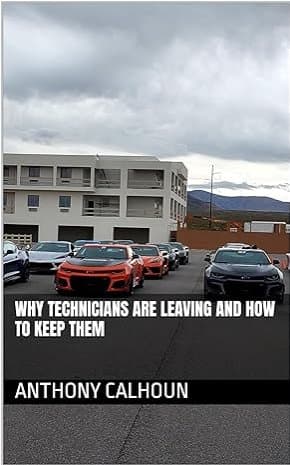
Why Technicians Are Leaving and How to Keep Them
Anthony Calhoun spent 25 years in the bays and behind the service desk. This book breaks down exactly why techs walk - and what shop leaders can do about it. Real stories, real data, no corporate fluff.
Get the book on Amazon →