
Why Do Mechanics Quit? An Insider’s Answer
By Anthony Calhoun - 25-Year ASE Master Technician, Author of “Why Technicians Are Leaving and How to Keep Them”
In over 25 years in this industry, I have watched an enormous amount of technicians come and go. I have watched them leave for other dealerships, exit the industry entirely, and burn out in shops that never gave them a reason to stay. And the question I get asked more than any other by shop owners and service directors is the same one: why do they quit?
They ask it like there is some mystery. Like their A-tech just vanished for no reason. But there is always a reason. Usually several. And they are almost never what management thinks they are. The industry needs to replace or add approximately 76,000 technicians every year. Only about 39,000 are graduating from training programs annually. That gap is projected to reach 642,000 or more unfilled roles by mid-decade. You cannot recruit your way out of a retention problem. If you want to understand why technicians leave, you need to start by understanding what their day actually looks like - and platforms like APEX Tech Nation exist because technicians have been asking for this kind of support for decades.
The Gap Between the Desk and the Bays
This is the big one. Service managers typically come from sales, service advising, or entirely different industries. Most are hardworking and genuinely want to succeed. The challenge is not character - it is context. Very few service managers have spent meaningful time as flat-rate technicians. They have a desk-side view of operations that misses the daily reality of the shop floor.
Managers count hours sold, effective labor rate, CSI scores, and gross profit. Technicians count minutes. Tenths of an hour, literally six minutes at a time, because their income depends on it. One side sees spreadsheets. The other sees a high-pressure environment where speed, accuracy, and quality must coexist under constant time scrutiny. Until managers understand that rhythm, the gap persists.
A few months ago, I posted a short video asking fellow technicians why they leave the industry or a dealership. The response was overwhelming. One technician put it this way:
“I worked at Ford for two years - the leadership sucked. They would come down in the middle of a job: ‘Hey, can you do this safety emissions real quick?’ Every single move you make at a dealership you have to clock in and out on a computer, which is time-consuming. I think it is poor management and poor money.”
That is not an outlier. That is the industry talking. The same pain I have felt and witnessed for decades is happening right now in your shop.
The Dealership Outcast
Here is something that does not get talked about enough. In most dealerships, technicians are the only major group of employees who are not regularly customer-facing. Salespeople are on the lot. Service advisors are at the write-up desk. Parts counter staff interact with walk-ins. But technicians are in the bays, under hoods and on lifts, invisible to the customers whose vehicles they are repairing and largely invisible to the rest of the dealership.
They are the backstage crew in a performance where everyone else gets the applause. Advisors and salespeople receive the face time, the recognition, the direct customer feedback. Technicians receive the blame when a job takes longer than expected or a hidden issue surfaces. When the department succeeds, it is rarely framed as the technicians succeeding. When something goes wrong, they are often the first to be pointed at.
This compounds. Technicians who feel invisible and undervalued start looking for exits. And in the current market, exits are not hard to find. Roughly 68 percent of technicians are detractors - meaning they would not recommend this field to anyone. That number should concern every Fixed Ops leader reading this.
Death by a Thousand Cuts
Most technicians do not leave for one big reason. It is death by a thousand cuts. One bad dispatch. One vague repair order. One unnecessary interruption. One slow parts pull. Each one is small. Together, they hollow out a paycheck and a person’s patience simultaneously.
I used to own a Tissot skeleton watch - an open-dial piece where you could see every gear turning, every mechanism in motion. That watch made me think deeply about what a flat-rate day actually looks like. Every gear in a good technician’s day needs to turn together. Momentum building from the first job into the second, parts ready when the job requires them, advisors clearing approvals cleanly, dispatching flowing in a sequence that makes sense.
When you interrupt a technician mid-flow - a vague repair order, a quick favor, an approval on a waiter that sits for hours - you are not just costing that technician a few minutes. You are throwing something into the gears. The watch stops. Real time keeps moving, but the technician’s planned day has been derailed. Do that multiple times in a week and the technician’s hours suffer. Do it consistently and you will eventually be posting a job listing. You are either helping them or hurting them - and they are keeping score.
Earned Respect Is the Real Currency
My son asked me at a young age how he could respect someone who had not earned it. I told him that no one can force respect, just like no one can force love. But a man of character treats everyone with basic dignity regardless. What I am talking about here is different. I am talking about the kind of respect that makes a technician want to go to battle with you every day, that makes them flag their best hours because they believe in the shop, that makes them answer your texts on a Saturday.
I have watched many managers cycle through dealerships. Technicians treated all of them with basic courtesy. But in shop talk, among themselves, the bad managers had zero genuine respect. The good ones earned it completely. And the difference in shop performance between a manager who is genuinely respected and one who is merely tolerated is not marginal. It is night and day. For a deeper dive into what actually keeps technicians from walking, read my piece on how to retain automotive technicians.
No Visible Future
Every technician in your shop should be able to tell you exactly what they need to do to reach the next level of income and skill. Not in vague terms - in specific terms. The certifications required, the training needed, what A-tech average earnings look like in your shop, and how long the path typically takes.
When technicians can see the path, they are far more likely to stay on it. When they cannot, they start evaluating their options. Giving your team access to automotive training for technicians signals that you are serious about their growth, not just their current flag hours.
What You Can Do Starting Tomorrow
You do not need a massive budget to start fixing this. Here is what you can do this week:
- Walk the shop. Ask a technician what their day looks like and what is getting in the way. Then actually fix the thing they name.
- Audit your dispatch. Is work being distributed fairly? Are your best technicians carrying all the warranty weight while someone else gets the gravy?
- Protect their time. Count how many interruptions happen in a typical day. Track how long approvals take. Each one of those is a tenth of an hour, and tenths add up to everything.
- Set honest expectations. Tell new hires the truth about hours, work mix, and shop culture. Technicians respect honesty far more than a sales pitch.
- Invest in growth. Look into ASE certification training and give your team the resources to develop.
The technicians who leave your shop are not ungrateful. They are not disloyal. They are people who decided that what you were offering was not worth what it was costing them. If you want them to stay, you have to make staying worth it. The technician shortage is real - but in most cases, it is being created by systems, cultures, and leadership patterns that can be changed.
About the Author
Anthony Calhoun is a 25-year automotive industry veteran, ASE Master Technician, and author of “Why Technicians Are Leaving and How to Keep Them.” He is still in the bays turning wrenches in 2026 while running AWC Consulting LLC, helping Fixed Ops leaders recruit, train, and retain the technicians who drive their profitability. For consulting inquiries, reach out at AWC@awcconsultingservices.com.
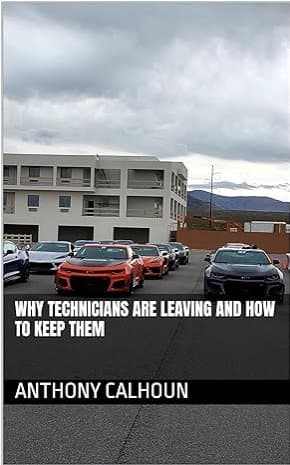
From the Author
Why Technicians Are Leaving and How to Keep Them
Anthony Calhoun spent 25 years in the bays and behind the service desk. This book breaks down exactly why techs walk - and what shop leaders can do about it. Real stories, real data, no corporate fluff.
Get the book on Amazon →